
Embodied carbon and operational carbon are two major sources of building emissions. Embodied carbon refers to the emissions released through the extraction, manufacturing, transportation, and construction of building materials. Operational carbon refers to the emissions produced while a building is in use, including heating, cooling, lighting, and ventilation. In facade design, the building envelope plays an important role because it affects material impact, energy consumption, durability, and long-term net-zero performance.
Key Takeaways:
- Embodied carbon in building materials arises from extraction, manufacturing, transportation, installation, maintenance, replacement, and end-of-life processes.
- Operational carbon in buildings comes from energy used for heating, cooling, lighting, ventilation, and daily operations.
- Net-zero facades should be evaluated using whole-life carbon because a facade can reduce energy demand while still generating material-related emissions.
- Low-carbon facade systems integrate efficient materials, durable assemblies, high thermal performance, and long service life.
- Solar-integrated facades can reduce operational carbon by converting part of the building envelope into an energy-generating surface.
What Is the Difference Between Operational and Embodied Carbon?
The distinction between operational and embodied carbon is that operational carbon is emitted when we use the building, whereas embodied carbon is emitted by the materials and processes involved in building, maintaining, and even dismantling the building. This difference is significant for facades, since the exterior envelope determines both.
Operational Carbon in Buildings
Operational carbon in buildings includes emissions from heating, cooling, lighting, ventilation, equipment, and other energy applications. A low-performing facade can increase HVAC demand, leading to higher operational emissions in the long run.
Embodied Carbon in Building Materials
Embodied carbon in building materials encompasses emissions from the extraction of raw materials, manufacturing, transportation, fabrication, installation, maintenance, replacement, and end-of-life treatment. This includes materials such as glass, aluminum, ceramic, insulation, stone, fasteners, and framing and attachment systems in facade systems.
Operational vs Embodied Carbon: Which Should Designers Prioritize?
Whole-life carbon should not be treated as a simple either-or choice between operational and embodied carbon. The most efficient facade approach balances initial material performance with long-term energy performance, durability, and maintainability.
Why Operational Carbon Still Matters
Sustainable building strategies over the years have paid much attention to operational carbon, as buildings have consumed a lot of energy in recent decades. That remains important, as heating, cooling, and ventilation can continue to be significant sources of a building’s carbon footprint.
Why Embodied Carbon Is Becoming More Important
With the efficiency of buildings and the cleanliness of the electricity grids, embodied carbon will be more apparent in the overall project footprint. The amount of carbon emitted before the building is opened can constitute a significant portion of the building’s life cycle.
Key Questions for Facade Design
For architects and developers, the key questions are practical:
- Can the facade reduce heating and cooling demand?
- Are the materials durable enough to avoid early replacement?
- Can the system limit unnecessary material weight?
- Does the product data support informed carbon decisions?
- Can renewable facade technology reduce operational energy consumption?
Elemex Facade Systems for Whole-Life Carbon Thinking
Elemex facade systems address both carbon dimensions in a single platform — the Unity® attachment system reduces structural weight while Solstex® converts the facade into an active energy source.
Why Facades Matter in Net-Zero Building Design
Facades are important in the design of net-zero buildings because they regulate the building’s response to heat, cold, sunlight, air, and moisture. A facade is not simply a surface finish but a performance layer that contributes to both operational and embodied carbon.
The scale is significant: UNEP’s 2024/2025 Global Status Report for Buildings and Construction says the buildings and construction sector consumes 32% of global energy and contributes 34% of global CO₂ emissions.
Facades and Operational Carbon
A high-performance facade can reduce operational carbon by improving insulation, regulating solar heat gain, enabling daylighting, and keeping the building dry. This minimizes HVAC loads and helps the building consume less energy.
Facades and Embodied Carbon
The embodied carbon of a facade is present in the materials and assemblies used to construct it, including aluminum, glass, insulation, stone, ceramic panels, subframes, clips, membranes, and finishes.
What Net-Zero Facades Mean
Net-zero facades are facade systems designed to reduce carbon emissions across the entire building by using energy efficiency, material efficiency, durability, and, in some cases, renewable energy.
How Much Carbon Does a Building Facade Contribute?
The embodied carbon in a building facade can constitute a significant portion of a project’s total embodied carbon, depending on the facade type, material combinations, glazing proportion, support framework, insulation, climate, replacement cycle, and building design. It does not have a universal number that applies to all projects.
Heavy-glazed commercial construction will tend to have a different carbon profile than a rainscreen facade with ceramic, aluminum, or natural stone panels. A facade that requires frequent replacement can also have a higher life-cycle impact than a system with a long service life.
Key facade-related carbon drivers include:
Material selection
Material choice directly affects embodied carbon. Aluminum, glass, steel, ceramic, natural stone, composite panels, insulation, and attachment systems all have different carbon profiles.
Thermal performance
Thermal performance affects operational carbon. Improved control of heat transfer can reduce heating and cooling loads.
Durability and maintenance
Longer-lasting systems can reduce replacement-related embodied carbon. Low-maintenance surfaces may also reduce recurring maintenance burdens.
System integration
Integrated facade platforms can simplify assembly coordination and reduce design conflicts. Elemex’s Unity® attachment technology supports multiple facade surfaces while maintaining system alignment.
How Low-Carbon Facade Systems Reduce Embodied Carbon in Building Materials
Low-carbon facade systems reduce embodied carbon in building materials by using efficient assemblies, durable materials, optimized attachment methods, and long-lasting components. The goal is not only to choose lower-impact materials but also to reduce unnecessary carbon across the entire system.
A low-carbon facade strategy may include:
- Selecting durable cladding materials with long service life.
- Avoiding overdesigned assemblies where lighter systems can perform.
- Using rainscreen systems to manage moisture and protect the wall assembly.
- Prioritizing materials with documented recycled content, LEED compliance letters, and low-VOC certifications — and planning ahead for EPD availability as project carbon reporting requirements grow.
- Designing for maintenance, repair, and replacement.
- Reducing thermal bridging where possible.
Elemex Material Options for Low-Carbon Facade Design
Ceramitex® uses low-VOC component materials, including DOWSIL™ 983 structural glazing sealant, which meets LEED IEQc4.1 requirements at under 20 g/L VOC — well below the 50 g/L limit — and contains no urea formaldehyde. LEED recycled content documentation for the panel system is available upon request.
Alumitex®/FR ACM panels carry a documented 33% LEED recycled content contribution (20% post-consumer, 25% pre-consumer) and are factory coil-coated — meaning zero VOCs are generated at the fabrication facility or on the jobsite. The production process is ISO 9001 certified. LEED documentation is available for project teams pursuing MR Credit 4.
For Ceramitex® projects, Elemex can also support low-carbon design conversations through its sintered ceramic supplier options. Two out of three Ceramitex® sintered ceramic suppliers claim carbon-neutral commitments: Dekton by Cosentino states that Dekton is carbon neutral across its life cycle, while Neolith states that it calculates 100% of its CO₂ emissions and offsets Scope 1 and 2 emissions. These supplier claims can help project teams evaluate ceramic facade options within a broader whole-life carbon strategy.
How Do Facades Support Net-Zero Buildings?
Facades support net-zero buildings by reducing energy demand, improving envelope performance, protecting materials, and sometimes generating renewable power. A facade can influence operational carbon and embodied carbon at the same time.
Reducing Energy Demand First
A net-zero-ready facade should help the building use less energy before renewable energy is added. This includes managing heat transfer, moisture, wind, solar exposure, and occupant comfort.
Using Solar Facades for Renewable Energy
Solar facade systems take this further. Elemex’s Solstex® is a building-integrated photovoltaic facade system that generates solar power as part of the building envelope. This makes the exterior wall part of the energy strategy, not just the exterior design.
Elemex’s Solstex® system uses photovoltaic glass supplied by Onyx Solar. As part of its sustainability commitments, Onyx Solar states that it plants one tree for every square metre of solar facade glass manufactured. This adds another supplier-level sustainability consideration for project teams evaluating building-integrated photovoltaic facade systems.
Balancing BIPV Embodied and Operational Carbon
This is where embodied vs operational carbon comes into play. A BIPV facade still contains embodied carbon because it is a manufactured product, yet it can help reduce operational carbon by generating electricity over time.
Best Low-Carbon Facade Systems for Commercial Buildings
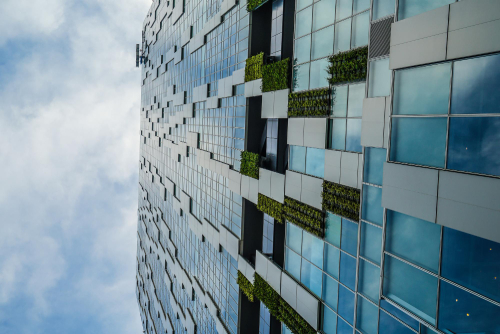
The best low-carbon facade systems balance embodied carbon, energy performance, durability, installation efficiency, and long-term maintenance. The right choice depends on climate, budget, building type, design goals, and carbon reduction targets.
| Facade System | Best For | Key Carbon Consideration |
| Ceramic rainscreen | Durable, low-maintenance commercial facades | Strong long-term performance; carbon depends on the panel and support system |
| Natural stone | Premium buildings needing a long service life | Higher weight, but durability can reduce replacement impacts |
| Aluminum facade | Lightweight, flexible, fast-install systems | Specify recycled-content or low-carbon aluminum where possible |
| High-performance curtain wall | Projects needing daylight, views, and transparency | Glass and aluminum must be optimized to reduce carbon and heat loss/gain |
| Solar-integrated facade | Net-zero or energy-focused buildings | Higher upfront complexity, but can reduce operational carbon through onsite energy generation |
Commercial project teams should compare facade systems using five filters: whole-life carbon, envelope performance, material durability, design integration, and supplier support.
For North American projects, Elemex offers low-carbon facade options in ceramic, aluminum, natural stone, and solar-integrated materials, helping teams balance carbon performance, durability, aesthetics, and cost.
Conclusion
The core message about embodied and operational carbon is that a net-zero facade should be treated as a whole-life-cycle system rather than an exterior finish. Improved envelope performance and the integration of renewable energy can reduce operational carbon, while smarter material and system selections can manage embodied carbon. Elemex unites these priorities through the performance, design flexibility and long-term project confidence of architectural facade systems. To compare facade options for your next commercial project, explore our product systems or contact us today to start a project-specific discussion.
FAQs:
What is the difference between operational and embodied carbon?
Operational carbon is the carbon emitted from energy used during a building’s operation. Embodied carbon refers to the carbon emitted during the production, transport, construction, maintenance, replacement and end-of-life of materials. Both are important in facade design, since the facade influences energy demand and generates material-related emissions.
How much carbon does a building facade contribute?
The carbon contribution of a building facade is determined by the types of materials used, the glazing percentage, framing, insulation, installations, the maintenance of the building facade, and the replacement rate. There is no single number for every building. The facade may be a major contributor to embodied carbon, as it may contain aluminum and glass, insulation, cladding panels, and support systems.
Can a facade reduce a building’s carbon footprint?
Yes, a facade can minimize a building’s carbon footprint by reducing heating and cooling needs, enhancing envelope performance, increasing material service life, and reducing replacement requirements. Solar-integrated facade systems can also help generate renewable energy, which can reduce operational carbon emissions over time.
Is embodied carbon more important than operational carbon?
Embodied carbon is not necessarily more important than operational carbon, but it is becoming a critical aspect of high-performance buildings. The use of the building generates operational carbon, whereas embodied carbon is usually emitted before the building opens. Net-zero design should evaluate both through whole-life carbon.
How do I choose a low-carbon facade system?
Select a low-carbon facade system by considering the impact of materials, durability, thermal performance, maintenance, climate suitability, code compliance, and supplier support. The best alternative is often the system that performs well over decades without unnecessary material weight, replacement, or operational energy requirements.
If you would like to learn more about Solar BIPV, please contact an Elemex representative.